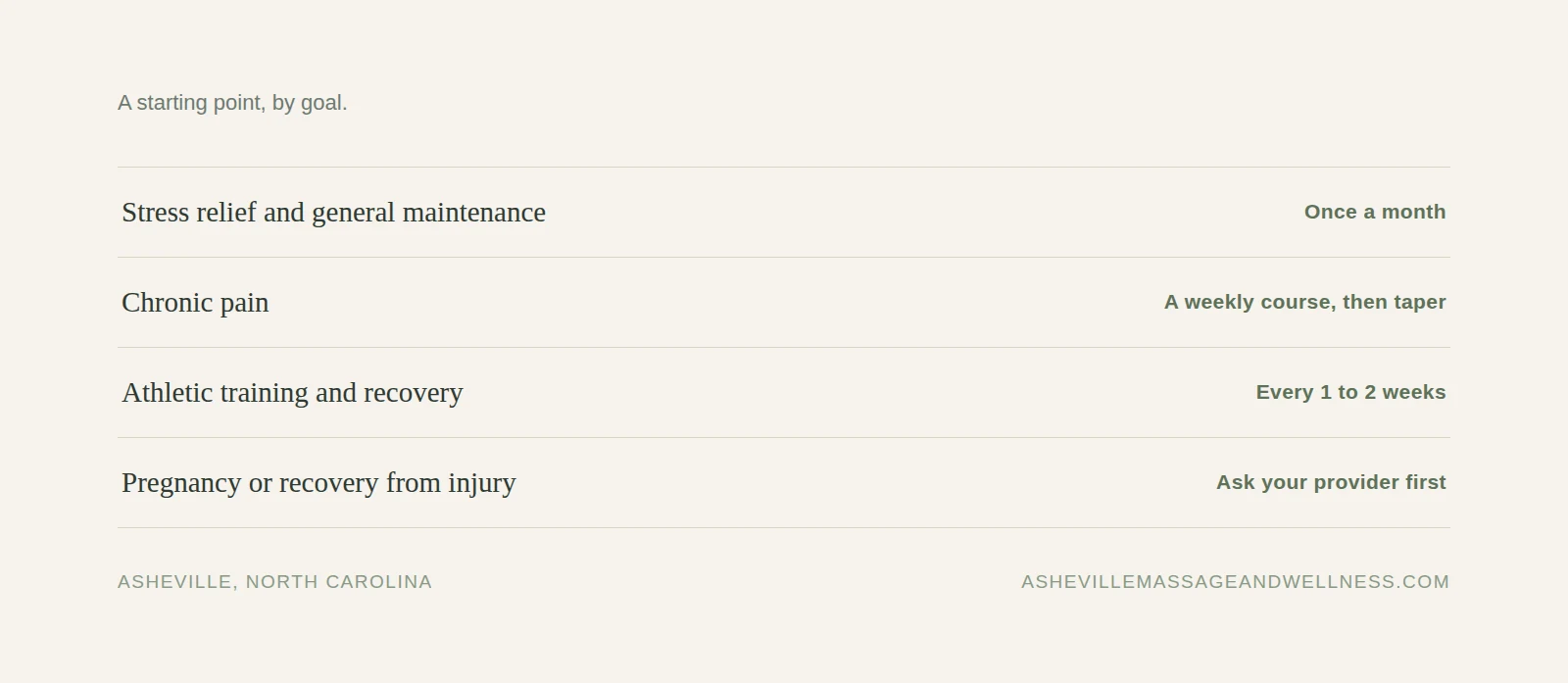
There is no single correct answer, but there is a useful one, and it depends on why you are booking in the first place. Someone managing chronic back pain and someone unwinding after a hard work week need different schedules.
Here is what the research actually shows, along with the practical scheduling that follows from it.
What the studies say about frequency
Two trials are worth knowing about, because both looked directly at how often and how long.
The first, published in Annals of Family Medicine in 2014, followed 228 adults with moderate to severe neck pain over four weeks. Participants receiving hour-long massages three times a week were five times more likely to report meaningful improvement than the control group. Twice a week produced three times the likelihood. Thirty-minute sessions performed noticeably worse than full hours.
The second, published in Annals of Internal Medicine in 2011, gave 400 adults with chronic low back pain one weekly hour-long massage for ten weeks. At the ten-week mark, more than one in three reported their pain was much better or gone, against one in twenty-five receiving usual care. Improved function was still measurable at six months. By one year, the benefit was no longer significant.
That final detail is the important one. The National Center for Complementary and Integrative Health makes the same point across conditions: the evidence for massage points to short-term benefit, and lasting effects have not been established. Massage is not a course of treatment you finish. It behaves more like exercise, where the results depend on continuing.
Chronic pain
A weekly course, then taper.
Both trials above used weekly or more frequent sessions for a defined block of time, four weeks in one case and ten in the other. That is the pattern to borrow: a concentrated run of sessions rather than an occasional visit, followed by a reduced schedule once symptoms improve.
The neck pain findings also suggest that session length matters. If the choice is between a longer session less often and a shorter one more often, the evidence favors the full hour of deep tissue or therapeutic work.
Stress relief and general maintenance
Around once a month.
No trial establishes a maintenance interval, so monthly is a practical convention rather than a research finding. It is common in the industry because it is affordable enough to sustain and frequent enough that most people notice the difference between keeping the appointment and skipping it.
Given that the measured benefits fade over months rather than persisting, some ongoing schedule makes more sense than an occasional one-off. Where exactly you land inside that range is a question of budget and how your body responds.
Athletic training and recovery
Every one to two weeks, adjusted around events.
The evidence base here is thinner than it is for pain, and claims about massage flushing lactic acid or speeding recovery are not well supported. What is reasonable is treating massage as part of a recovery routine rather than a performance enhancer.
The standard practice among sports therapists is to keep work light in the days immediately before a competition, since deep work can leave tissue temporarily sore, and to save the deeper sessions for afterward. Discuss timing with your therapist ahead of a race rather than the day before.
Pregnancy, injury, or ongoing medical care
Ask your provider first.
The American Pregnancy Association notes that massage can be appropriate at any stage of pregnancy, though many practices decline first-trimester bookings, and it advises discussing massage with your prenatal care provider beforehand. It flags several conditions that warrant a conversation with a doctor first, including high-risk pregnancy, preeclampsia, pregnancy-induced hypertension, a history of pre-term labor, recent bleeding, and severe swelling or headaches.
The same principle applies to anyone recovering from surgery or injury. Frequency should be set with your physician or physical therapist rather than decided independently.
What else affects the right interval
Beyond the goal, a few factors reasonably shift the schedule:
- Physical demands of your work. Repetitive occupations, whether that is a desk, a trade, or a salon chair, tend to reproduce the same strain on a predictable cycle.
- Stress levels. Massage has measurable short-term effects on anxiety, though NCCIH characterizes the overall evidence as limited. Busier seasons are the ones where a standing appointment is most likely to be cancelled and most likely to help.
- What you do between sessions. Movement, stretching, and hydration are the parts of the picture massage cannot replace. For more on the last one, see this breakdown of how to calculate your daily water intake.
- Cost. A schedule that is not sustainable is not a schedule. It is better to hold a realistic monthly appointment than to plan a weekly one and abandon it in six weeks.
Can you get a massage too often?
For healthy adults, frequent massage is generally considered safe when performed by a licensed therapist. The neck pain trial used up to three sessions a week for four weeks without safety concerns, and its authors concluded that massage appears safe when delivered by trained practitioners.
Deep pressure is a different question from frequency. Deep tissue work can leave the area tender for a day or two, so on a frequent schedule it is reasonable to alternate deeper sessions with lighter Swedish work. Tell your therapist how you felt in the days after your last visit, since that is the information they use to set pressure.
The short version
For a specific pain problem, book a concentrated run of weekly hour-long sessions and reassess after four to ten weeks, which is the window both trials used. For general wellbeing, pick an interval you can actually keep, with monthly being the common default. For pregnancy or any active medical issue, start with your provider.
If cost is the obstacle to consistency, a monthly membership is designed for exactly that. And if you are unsure where you fall, ask at your next appointment.
Sources
- Sherman KJ et al., Annals of Family Medicine, 2014, via University of Washington School of Public Health
- Cherkin DC et al., Annals of Internal Medicine, 2011, via Kaiser Permanente Washington Health Research Institute
- National Center for Complementary and Integrative Health, Massage Therapy for Health: What the Science Says
- American Pregnancy Association, Prenatal Massage